
Preserving the Grammar of Reverence
“Lux perpetua luceat eis.”
“Let perpetual light shine upon them.”
The phrase comes from the ancient Requiem Mass, a prayer of the Church entrusting the faithful departed to the mercy of God and asking that they may rest in the light of His presence. It is from this prayer that the first collection of Lex Orandi receives its name.
Lex Orandi—the law of prayer—is Shannon Zabawa’s broader artistic mission to preserve the grammar of Catholic worship: the visual, symbolic, and spiritual language through which the Church has expressed her faith across centuries.
Inspired by the ancient principle lex orandi, lex credendi—the law of prayer is the law of belief—this work reflects the conviction that the way the Church worships shapes the way her children encounter God. Sacred architecture, liturgical tradition, ritual, silence, music, and beauty are not merely external expressions. They form a language through which the faith is handed down.
Lux Perpetua is the first expression of this mission.
It seeks to preserve one particular element of that language:
the grammar of reverence.
A Collection of Four Sacred Altars
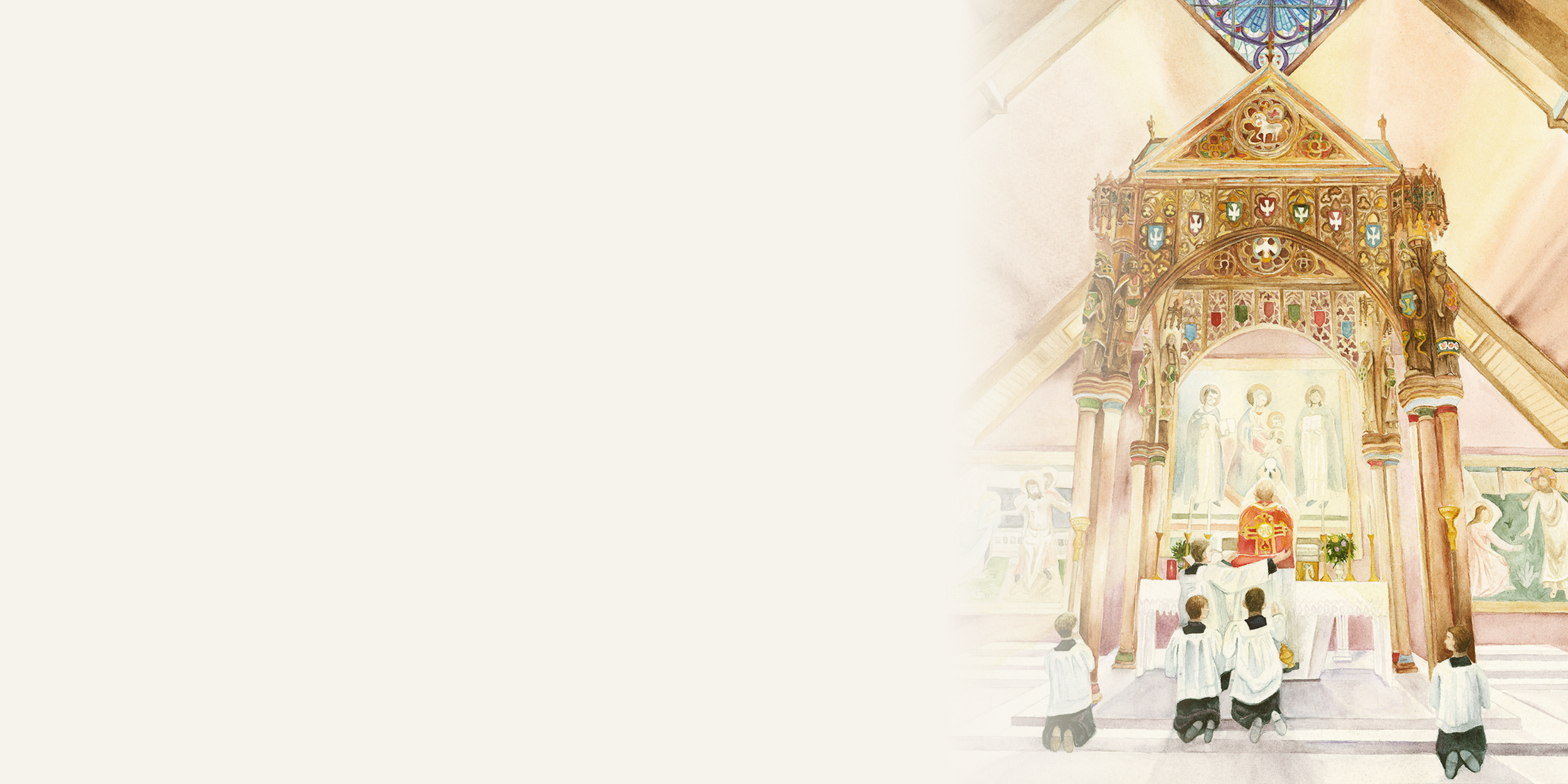
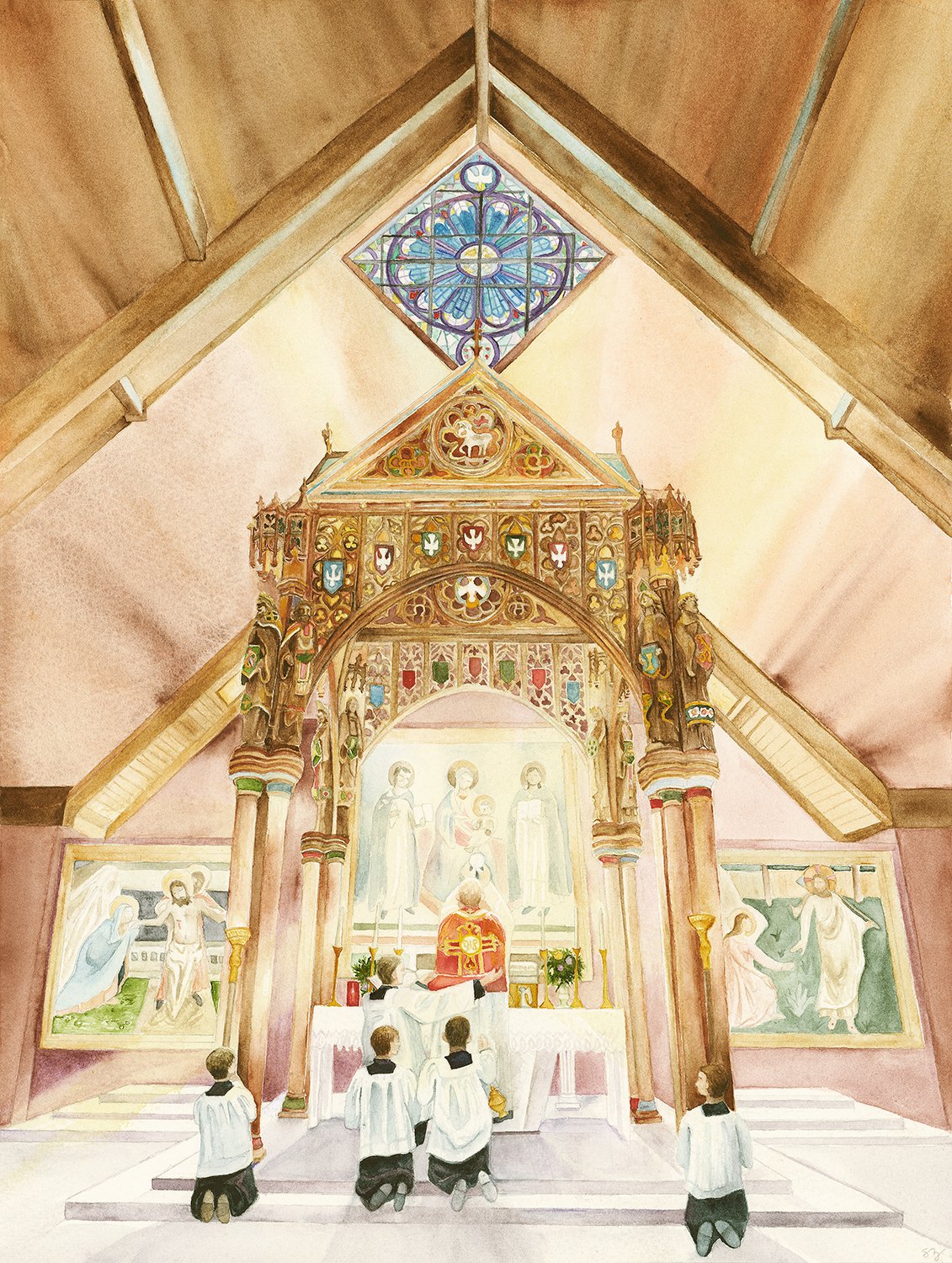
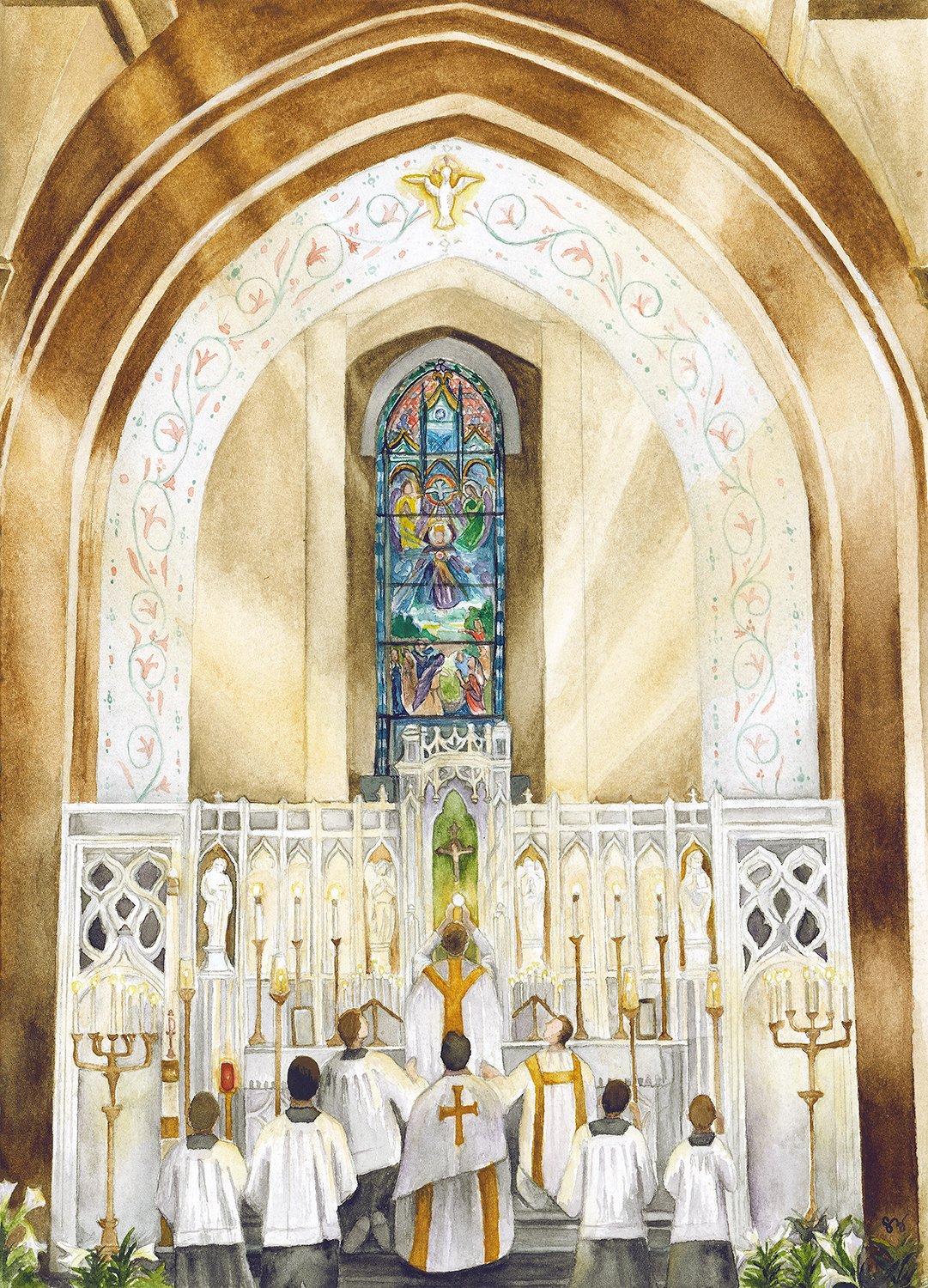
Lux Perpetua is a collection of watercolor paintings depicting four parish altars within the Diocese of Charlotte, each painted at the moment of the Elevation—the solemn moment during the Holy Sacrifice of the Mass when the Sacred Host is raised in adoration.
It is a moment suspended between Heaven and earth.
The candles illuminate the sanctuary.
The faithful kneel in silence.
The priest lifts Christ before His people.
The visible world becomes a window into an invisible mystery.
Each painting captures this moment within a different season of the traditional liturgical calendar, allowing the collection to move through a full year of Catholic worship:
Christmastide — the mystery of the Incarnation, when the Light of the World enters into darkness.
Lent — the solemn journey toward the Cross, marked by repentance and sacrifice.
Easter — the radiant triumph of the Resurrection, filled with the joy of new life.
Pentecost — the fire of the Holy Spirit descending upon the Church.
Together, these four works form a meditation on the enduring light of Christ as it is encountered through the sacred rhythms of the liturgy.
Four Parishes, One Tradition
The four churches represented in Lux Perpetua are:
St. Thomas Aquinas Catholic Church — Charlotte, North Carolina
Our Lady of Grace Catholic Church — Greensboro, North Carolina
St. Ann Catholic Church — Charlotte, North Carolina
St. John the Baptist Catholic Church — Tryon, North Carolina
These parishes share a unique place in the recent history of Catholic worship in the Diocese of Charlotte.
At one point, nine parish communities throughout the diocese offered the Traditional Latin Mass, forming a growing network of Catholics drawn to the beauty, reverence, and continuity of worship. These communities included families, young people, and faithful Catholics who discovered in the traditional liturgy a profound encounter with the mysteries of the faith.
In recent years, these communities experienced significant changes regarding the celebration of the Traditional Latin Mass.
Lux Perpetua is not a work born from controversy, but from contemplation.
It is an act of looking closely at something worth looking at.
At altars where generations of Catholics have prayed.
At sacred spaces where the Mass has been offered.
At a moment in the liturgy—the Elevation—that has drawn souls into adoration for centuries.
The paintings are a reflection on the enduring relationship between worship and belief, and on the sacred inheritance carried by those who have preserved this tradition through times of uncertainty.
St Thomas Aquinas Catholic Church in Charlotte, NC
Our Lady of Grace Catholic Church in Greensboro, NC
The Grammar of Reverence
For centuries, Catholic worship developed a profound visual and spiritual vocabulary.
The sanctuary ordered toward the altar.
The silence before the mystery.
The incense rising like prayer.
The candles surrounding the sacrifice.
The beauty of sacred vestments and vessels.
The chant lifting the heart beyond ordinary things.
The reverent gestures of priest and people.
Together, these elements form the grammar of reverence.
Like the grammar of a language, they give structure and meaning to expression. They teach the soul how to approach what is sacred.
The Traditional Latin Mass represents one of the most complete expressions of this inherited language. Through its silence, symbolism, orientation, and careful ceremonial, it communicates a vision of worship centered not upon ourselves, but upon God.
Throughout history, this tradition has endured because faithful souls recognized that some treasures are too precious to abandon. Priests, families, musicians, artisans, and communities have carried this inheritance forward, often quietly and with great sacrifice.
The light has continued because faithful hands have continued to carry it.
More Than a Record of Place
A church is never merely stone and wood.
An altar is never merely an object.
Sacred spaces hold the memory of prayer.
They bear witness to baptisms, confessions, marriages, funerals, and countless moments when souls encountered the grace of God.
The purpose of sacred architecture has always been to lift the human heart beyond itself.
Every arch points upward.
Every image teaches.
Every candle speaks of Christ.
Every sanctuary directs the soul toward worship.
The purpose of Lux Perpetua is not simply to preserve what these churches looked like.
It is to preserve what they meant.
Each painting becomes less a record of a place and more a meditation on the sacred reality that unfolded there.
Watercolor as an Act of Preservation
Watercolor felt like the natural medium for this collection.
Its transparency allows light to emerge through layers of color. Pigment gathers in shadow and reveals itself gradually, only fully appearing where darkness gives way to light.
In its own small way, watercolor reflects what these paintings seek to express.
The mystery of faith often unfolds through layers.
Tradition.
Symbol.
Silence.
Beauty.
Prayer.
The hidden realities of worship revealed through visible signs.
Each painting is therefore not merely an image of an altar.
It is an invitation to contemplation.
The Light Shines in the Darkness
The history of the Church is filled with moments when traditions appeared fragile.
Yet again and again, faithful souls preserved what they had received.
The Church has always depended upon those willing to carry the light forward.
The monks who preserved manuscripts.
The artisans who created sacred beauty.
The families who passed down prayers.
The communities who continued to worship.
The faithful who guarded treasures they knew were worth preserving.
Lux Perpetua honors that quiet fidelity.
The light may be obscured.
The flame may appear fragile.
But the light remains.
“The light shines in the darkness, and the darkness has not overcome it.”
— John 1:5