
Our Lady of Grace Catholic Church,
Greensboro, North Carolina
Original Watercolors by Shannon Zabawa
Lux Benedicta Studio
Part of the Lux Perpetua Collection
Our Lady of Grace Catholic Church Watercolor Artwork
The sanctuary of Our Lady of Grace Catholic Church in Greensboro, North Carolina has become one of the most recognizable sacred interiors in the American Traditional Catholic community. For many faithful, it represents not simply an architectural space, but a place where generations have encountered Christ through the Holy Sacrifice of the Mass, Eucharistic devotion, and parish life rooted in Catholic tradition.
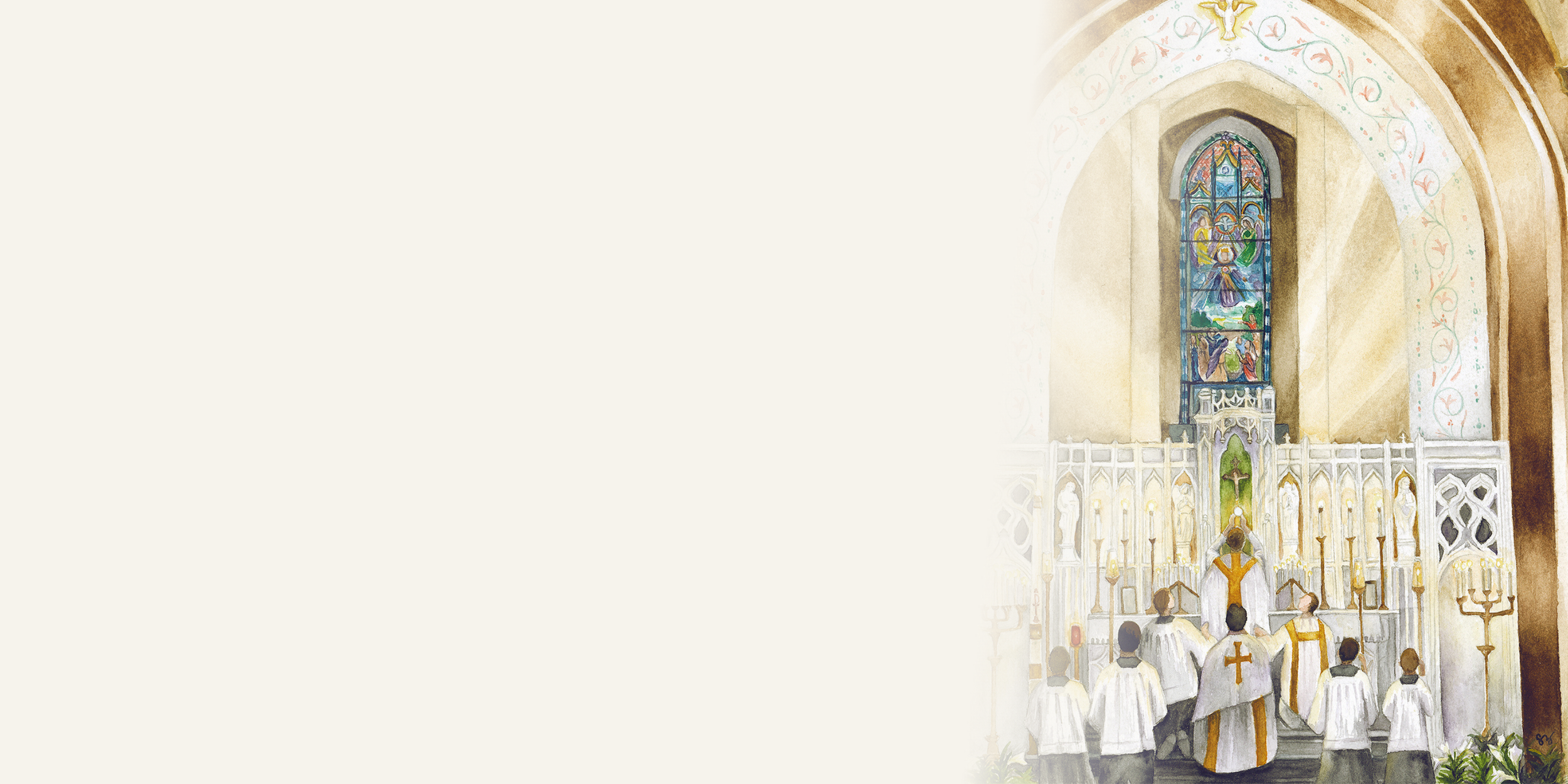
Artist Shannon Zabawa has painted two original watercolor works inspired by Our Lady of Grace. While distinct in subject and composition, both paintings seek to preserve the spiritual atmosphere of this beloved church rather than merely document its physical appearance.
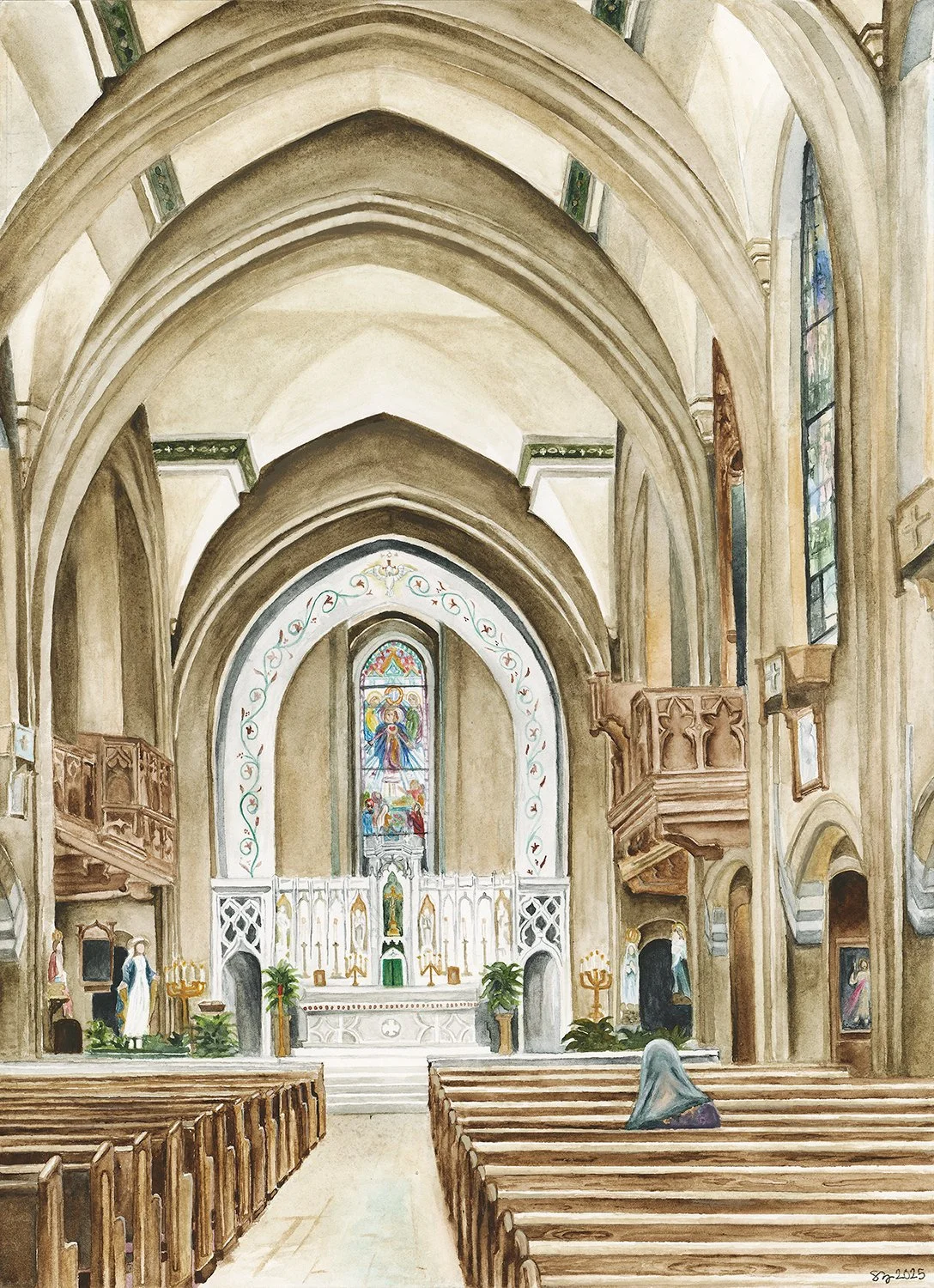
The first, part of the Lux Perpetua Collection, portrays the sanctuary itself illuminated during the celebration of the Sacred Liturgy. The second offers a quieter meditation: a solitary woman kneeling in prayer before the sanctuary, inviting viewers to contemplate the intimate encounter between the individual soul and Christ truly present in the Eucharist.
Together, these works explore two complementary dimensions of Catholic worship—the communal offering of the Holy Sacrifice of the Mass and the deeply personal life of prayer that flows from it.
Rather than functioning as architectural illustrations, these paintings are intended as acts of visual meditation, preserving the beauty of a sacred place while inviting renewed reflection upon the mysteries celebrated within it.
The Watercolor Story
At a Glance
Artist: Shannon Zabawa
Artwork Title: Donec Venias
Medium: Original Watercolor
Collection: 
Studio: Lux Benedicta Studio
Church: Our Lady of Grace Catholic Church
Location: Greensboro, North Carolina
Diocese: Diocese of Charlotte
Liturgical Moment: Elevation of the Holy Eucharist during Easter
Theme: The descent of the Holy Spirit and the Eucharistic mystery
Every sacred space possesses a unique atmosphere—one that cannot be measured by architectural drawings or captured completely through photography. It is found in the quiet before Mass, the glow of candlelight against stone, the filtered light passing through stained glass, and the stillness that settles over a congregation during the Consecration.
These are the moments Shannon Zabawa seeks to preserve.
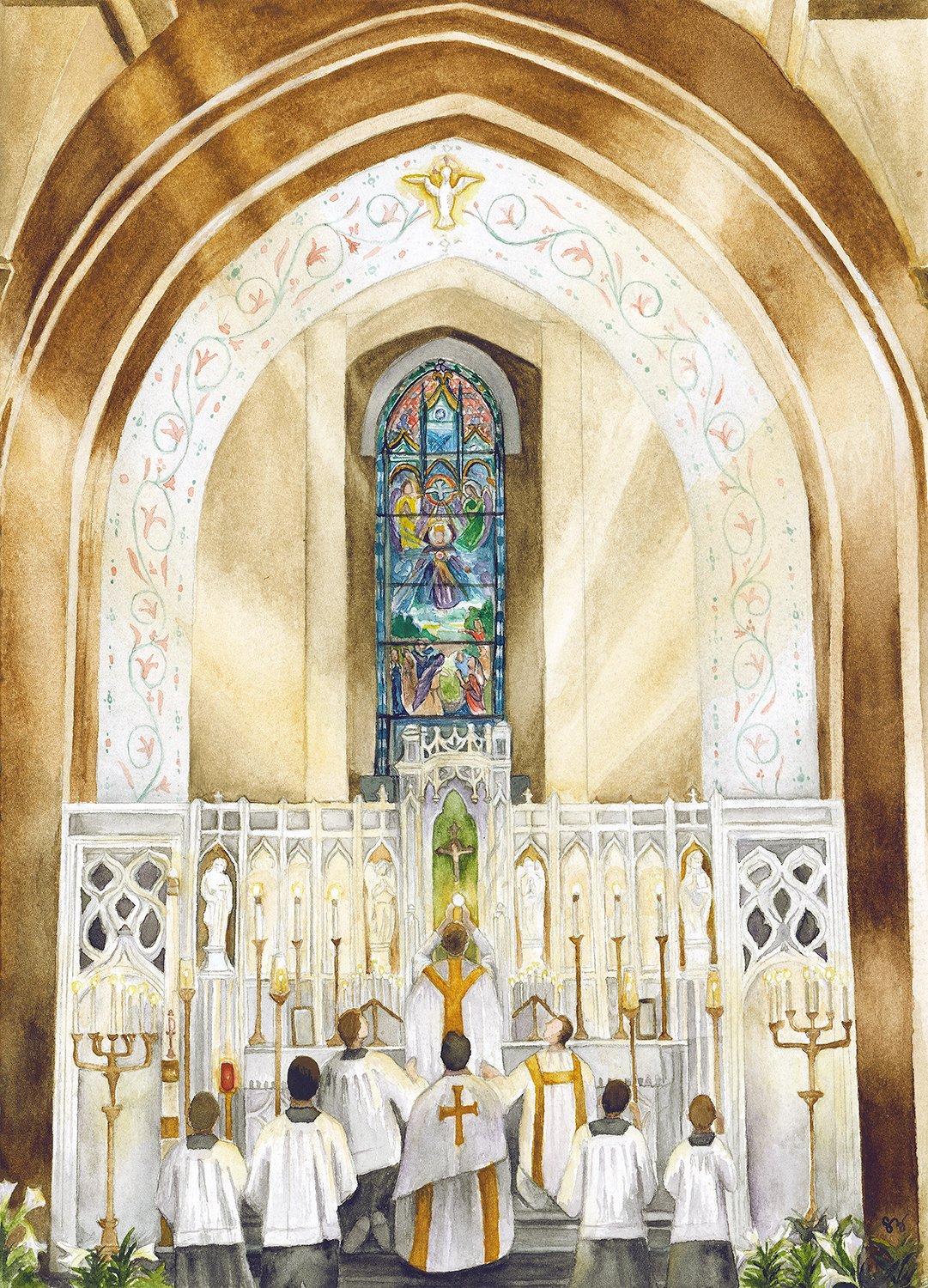
For Donec Venias, the Easter Vigil was chosen intentionally because it embodies the central mystery of Christianity: Christ has risen, and through His Resurrection all things are made new.
The composition quietly guides the eye toward the altar. Gothic arches lift the viewer’s gaze upward while warm washes of watercolor allow light to emerge naturally through transparent layers of pigment. Architectural detail remains faithful to the sanctuary, yet the painting intentionally simplifies secondary elements so that the Eucharist becomes both the visual and theological center of the work.
Rather than recreating a single photograph, the painting is an artistic meditation developed through firsthand observation, architectural study, compositional sketches, and numerous photographic references gathered on location.
The resulting work invites contemplation rather than documentation. Every element—light, perspective, color, and composition—serves one purpose: directing the viewer toward Christ present in the Eucharist.
At a Glance
Artist: Shannon Zabawa
Artwork Title: Our Lady of Grace Church
Medium: Original Watercolor
Collection: Open
Studio: Lux Benedicta Studio
Church: Our Lady of Grace Catholic Church
Location: Greensboro, North Carolina
Diocese: Diocese of Charlotte
Liturgical Moment: Elevation of the Holy Eucharist during Pentecost
Theme: The descent of the Holy Spirit and the Eucharistic mystery
Alongside Donec Venias, Shannon Zabawa created a second watercolor inspired by the same sanctuary.
Rather than depicting the liturgy, this companion work captures the quiet majesty of Our Lady of Grace through the eyes of a solitary woman kneeling in prayer. Bathed in gentle daylight beneath the church’s soaring Gothic arches, the sanctuary becomes a place of intimate encounter between the individual soul and God.
The immense scale of the architecture emphasizes a profound theological truth: before the infinite majesty of God every person is humble, dependent, and yet infinitely loved. Though physically small within the composition, the kneeling woman represents every believer who enters seeking consolation, forgiveness, guidance, or simply a moment of silence before the Blessed Sacrament.
Above her shines the image of Our Lady of Grace, quietly directing all attention toward Christ upon the altar. Through delicate washes of warm stone, filtered light, and carefully observed architectural detail, the painting reflects the paradox at the heart of Christianity: the Creator of the universe lovingly invites every soul into His presence.
Inspired by Psalm 84—“How lovely is your dwelling place, O Lord of hosts”—this companion watercolor serves as a meditation on sacred architecture, personal prayer, and the peace found within God’s house.

Collection
Donec Venias forms part of the Lux Perpetua Collection, a series of original watercolor paintings depicting four parish altars within the Diocese of Charlotte during the Elevation of the Host.
Each work corresponds to a season of the traditional liturgical year, allowing the collection to unfold as a visual meditation on Christmastide, Lent, Easter, and Pentecost.
Together, these paintings contemplate the enduring relationship between sacred worship, sacred architecture, and the theological truths expressed through the Church’s liturgy.
Explore the complete Lux Perpetua Collection to discover the story behind all four paintings.
Liturgical Significance
The Holiest Night of the Church’s Year
This watercolor captures one of the most solemn and triumphant moments of the Easter Vigil: the elevation of the Holy Eucharist as the Church proclaims Christ’s definitive victory over sin, death, and the powers of darkness.
Celebrated on the night that stands at the very heart of the liturgical year, the Easter Vigil begins in darkness and culminates in radiant light, tracing salvation history from creation to resurrection. It is the night when the Church keeps watch at the tomb, rejoices at the Resurrection, and renews her hope in the promise of eternal life.
The setting of the Easter Vigil was chosen intentionally because it embodies the central message of the Christian faith: Christ has risen, and through His Resurrection all things are made new.
Throughout the liturgy, darkness gradually gives way to light as the Paschal Candle is carried into the church and the faithful receive its flame—a visible reminder that Christ is the Light of the World.
The Eucharist at the Center
Beneath the soaring Gothic arches of Our Lady of Grace, the priest stands ad orientem, leading the faithful in worship toward God.
Servers and clergy kneel in reverent silence before the sacred mystery unfolding upon the altar.
At the center of the composition, the consecrated Host is elevated high above the altar, radiant with light. The Eucharist becomes both the visual and spiritual focal point of the painting, reminding the viewer that the same Christ who emerged victorious from the tomb remains truly present among His people in the Blessed Sacrament.
The Resurrection is not merely remembered—it is made sacramentally present through the Holy Sacrifice of the Mass.
Mary, Our Lady of Grace
Above the sanctuary shines the great stained-glass image of the Blessed Virgin Mary under her title Our Lady of Grace.
Positioned above the altar, she gently directs every gaze toward her Son. Her place within the composition reflects the timeless teaching of the Church: Mary’s mission is always to lead souls to Jesus.
Her presence reminds the faithful that she accompanies the Church on her pilgrimage of faith, continually interceding for her children and leading them ever more deeply into the mystery of Christ’s sacrifice, Resurrection, and Eucharistic presence.
Light That Cannot Be Overcome
The abundance of white throughout the sanctuary recalls the baptismal garments worn by the newly initiated during the Easter Vigil and symbolizes purity, redemption, and participation in Christ’s victory.
The interplay of light throughout the painting emphasizes the Christian conviction that no darkness—whether sin, suffering, uncertainty, or death—can overcome the light of Christ.
The title Donec Venias, meaning “Until You Come,” is drawn from Saint Paul’s words:
“For as often as you eat this bread and drink the cup, you proclaim the death of the Lord until He comes.”
— 1 Corinthians 11:26
The phrase beautifully unites the themes of the painting. Every Mass remembers Calvary, celebrates Christ’s living Eucharistic presence, and anticipates His glorious return.
Painted with delicate washes and luminous transparency, Donec Venias becomes a meditation on resurrection, worship, hope, and the enduring promise that Christ remains with His Church until the end of the age.
“The light shines in the darkness, and the darkness has not overcome it.”
— John 1:5
Sacred Architecture of Our Lady of Grace
Sacred architecture has always been more than construction. Throughout the history of the Catholic Church, churches have been designed to teach theology through proportion, beauty, light, and symbolism.
The sanctuary of Our Lady of Grace exemplifies this tradition.
Inspired by Gothic architecture, its soaring arches naturally lift the eye upward, reminding worshippers that every liturgy is a participation in the worship of Heaven. The sanctuary is carefully ordered around the altar, where the sacrifice of Calvary is made sacramentally present in every Mass. The tabernacle, stained glass, statuary, candles, and sacred furnishings work together as a unified visual catechism, communicating truths that words alone cannot express.
Above the sanctuary, the great image of Our Lady of Grace quietly reinforces the Church’s understanding of Mary as Mother of God and Mother of the faithful. Her elevated position reflects her role within salvation history while continually directing attention toward Christ.
Rather than existing simply as decoration, every architectural element serves the liturgy. Beauty becomes an act of evangelization, inviting both lifelong Catholics and first-time visitors into deeper contemplation of the mysteries celebrated within the church.
History of
Our Lady of Grace Catholic Church
Our Lady of Grace Catholic Church has been a cornerstone of Catholic life in Greensboro for generations. Established during a period of significant growth for the Catholic population of North Carolina, the parish developed into one of the region’s largest and most active Catholic communities, serving thousands of families through the celebration of the sacraments, Catholic education, charitable outreach, and lifelong formation in the faith.
Dedicated under the title of Our Lady of Grace, the parish reflects a long tradition of Marian devotion within the Church. This title recalls the Blessed Virgin Mary’s unique role in salvation history and her continual intercession for all who seek her Son. From its earliest years, the parish has sought to foster a life centered on the Eucharist, devotion to Our Lady, and faithful participation in the liturgical life of the Church.
The church itself was designed with a sanctuary that communicates reverence through its Gothic-inspired architecture, soaring arches, stained glass, and strong visual focus on the altar. These elements place Our Lady of Grace within a long lineage of Catholic sacred architecture that uses beauty not merely for ornamentation but as a means of lifting the mind and heart toward God.
Beyond its architectural beauty, Our Lady of Grace has become especially significant within the Diocese of Charlotte for its rich liturgical life. For many years, the parish was one of the principal locations where the Traditional Latin Mass was celebrated, drawing faithful from throughout central North Carolina. Catholics traveled considerable distances to worship within this sanctuary, making it a place of pilgrimage and spiritual home for many families deeply devoted to the Church’s liturgical heritage.
This history forms part of the broader story of Catholic worship in North Carolina. The sanctuary depicted in this painting has witnessed baptisms, confirmations, weddings, funerals, Easter Vigils, ordinations, and countless celebrations of the Holy Sacrifice of the Mass. It has served as a place where generations have encountered Christ in the sacraments and found strength in prayer.
Today, Our Lady of Grace continues its mission as a vibrant Catholic parish, preserving a legacy of faithful worship while welcoming new generations into the life of the Church.
Why Paint Catholic Churches?
Churches were never intended merely to shelter worship. They were built to proclaim the Gospel through beauty.
For centuries, Catholic artists, architects, and craftsmen have understood that sacred spaces teach the faith long before a sermon begins. Stone, stained glass, candles, proportion, music, and light all become instruments of catechesis, directing hearts toward the mysteries celebrated upon the altar.
Lux Benedicta Studio exists to preserve these sacred places through original watercolor paintings that unite architecture, theology, and artistic craftsmanship.
Each painting is intended not simply as an architectural portrait, but as a visual meditation on the encounter between God and His people.
The Artist’s Process
Every Lux Benedicta Studio watercolor begins with firsthand experience.
Before a brush ever touches paper, Shannon Zabawa spends time studying each church from multiple perspectives, observing how architecture shapes the experience of worship and how light transforms the sanctuary throughout the liturgical year. Numerous reference photographs, compositional sketches, and architectural studies are gathered before the final painting begins.
The work then develops slowly through successive transparent washes of watercolor. Each layer deepens color while allowing light to emerge naturally from the paper itself, preserving the luminous quality that makes watercolor uniquely suited to depicting sacred interiors.
Rather than striving for photographic realism, the goal is to communicate atmosphere—to preserve the stillness, reverence, and sacred beauty experienced within these churches.
Whenever possible, Lux Benedicta Studio shares process photographs, preliminary sketches, and works in progress as part of its commitment to original authorship, artistic transparency, and craftsmanship.
Available Prints
Each reproduction is produced from a high-resolution archival scan of the original watercolor to preserve the transparency, luminous color, and delicate detail of the painting.
Available options include:
Museum-quality archival fine art paper
Multiple standard frame sizes
Ready-to-frame prints
Limited original artwork availability when offered
Every print is carefully inspected before shipment and is intended to become a lasting heirloom for the home, office, parish, or prayer space.
Whether displayed as a reminder of a beloved parish or as a meditation on the beauty of the Eucharistic liturgy, this artwork invites contemplation of the mysteries at the heart of the Catholic faith.