
Introducing

Lex orandi, lex credendi — as we pray, so we believe.
It’s an old maxim, older than any of the parishes in this collection, and it sits at the center of a new body of work we’re calling Lex Orandi. The project unfolds in three chapters, each one a meditation on a different facet of how the liturgy shapes what we believe: the altar at the moment of Consecration, the threshold of the altar rail, and the seven sacraments themselves. We’re beginning with the first.
Lux perpetua luceat eis — let perpetual light shine upon them. The phrase comes from the Requiem, and it gives this first collection its name.
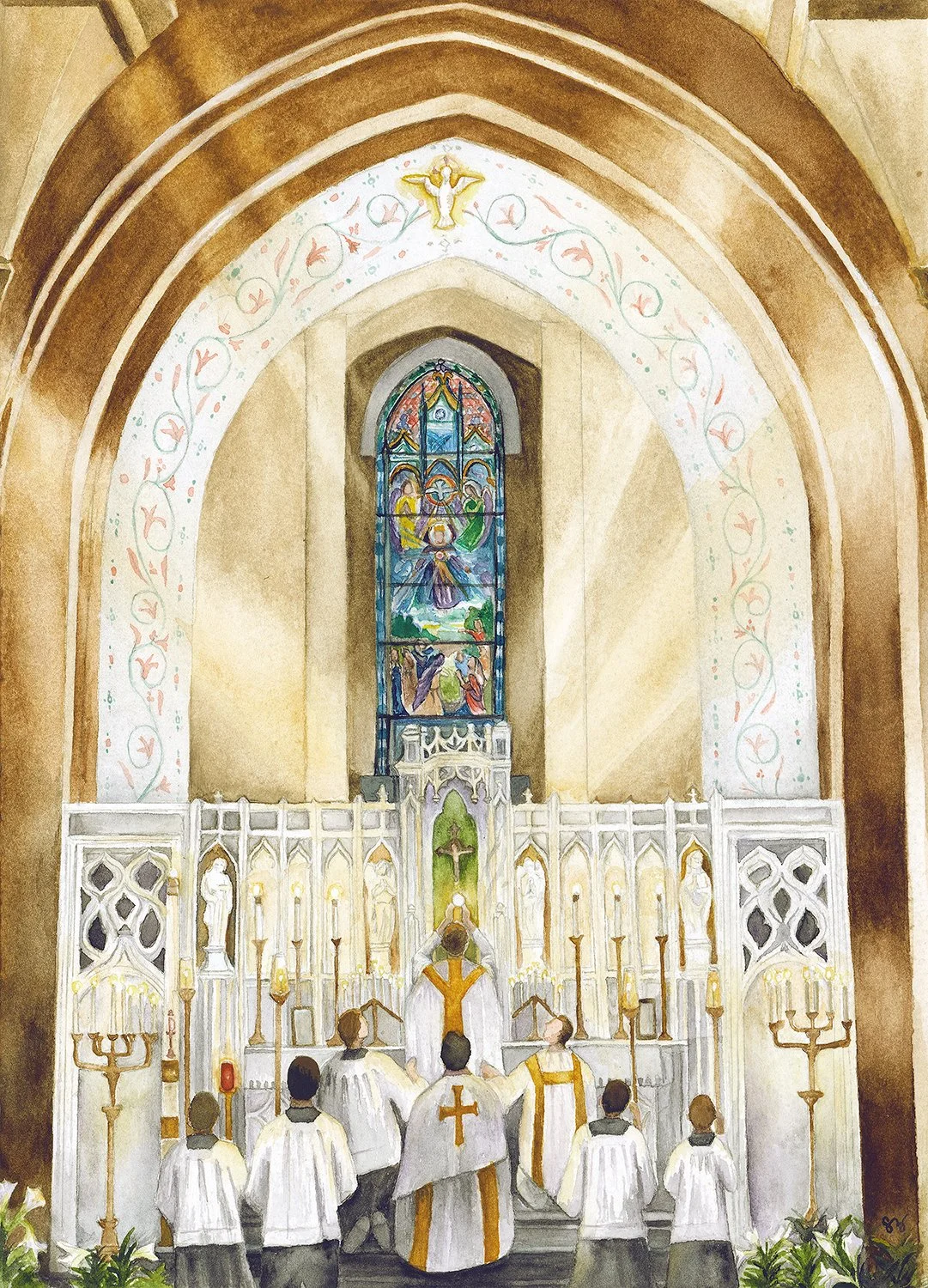
Lux Perpetua is a collection of watercolor paintings of four parish altars in the Diocese of Charlotte, each one painted at the instant of the Elevation — the moment the Host is raised in adoration, the room caught between candlelight and shadow. Each painting corresponds to a different season of the traditional liturgical calendar, so the four works move through a full year of light: the beauty of Christmastide, the starkness of Lent, the white of Easter, the fire of Pentecost.
These four parishes share something else. In recent years, each was affected by a time of significant liturgical changes placed on the Traditional Latin Mass. Lux Perpetua, a reflection on the ancient liturgy, is simply an act of looking closely at something worth looking at — at altars where that Mass was offered, at a moment in the liturgy that has been offered the same way for centuries, regardless of what was happening around it.
These paintings also serve as a quiet reflection on the inseparable bond between worship and belief. They invite the viewer to consider that the Church’s liturgical traditions are not merely inherited customs but living expressions of the faith that have shaped generations of Catholics. As the way we pray influences the way we believe, the preservation and contemplation of these sacred forms becomes an act of remembering the theological and spiritual heritage they embody.
Watercolor felt like the perfect medium for this. Its transparency allows light to emerge through layers of color, its pigment pooling into shadow and only fully revealing itself where the shadows end and light breaks through — which is, in its own small way, exactly what these paintings are about. Each painting becomes less a record of a place and more a meditation on what that place meant.


Where things stand:
Several paintings in Lux Perpetua are complete; the remaining works are in progress, moving through the liturgical seasons as the year does. We’ll share each piece as it’s finished.
Our hope is that these paintings invite viewers to pause, remember, and contemplate the mysteries that unite Catholics across centuries and continents.
Because some traditions are worth preserving.
And the grammar of reverence deserves to be handed on.
The light shines in the darkness, and the darkness has not overcome it. — John 1:5