
St. Thomas Aquinas Catholic Church,
Charlotte, North Carolina
Original Watercolors by Shannon Zabawa
Lux Benedicta Studio
Part of the Lux Perpetua Collection
The Holy Sacrifice of the Mass is the heart of Catholic life. It is here, upon the altar, that heaven touches earth, Christ renews His one sacrifice sacramentally, and the faithful are drawn into the mystery of redemption.
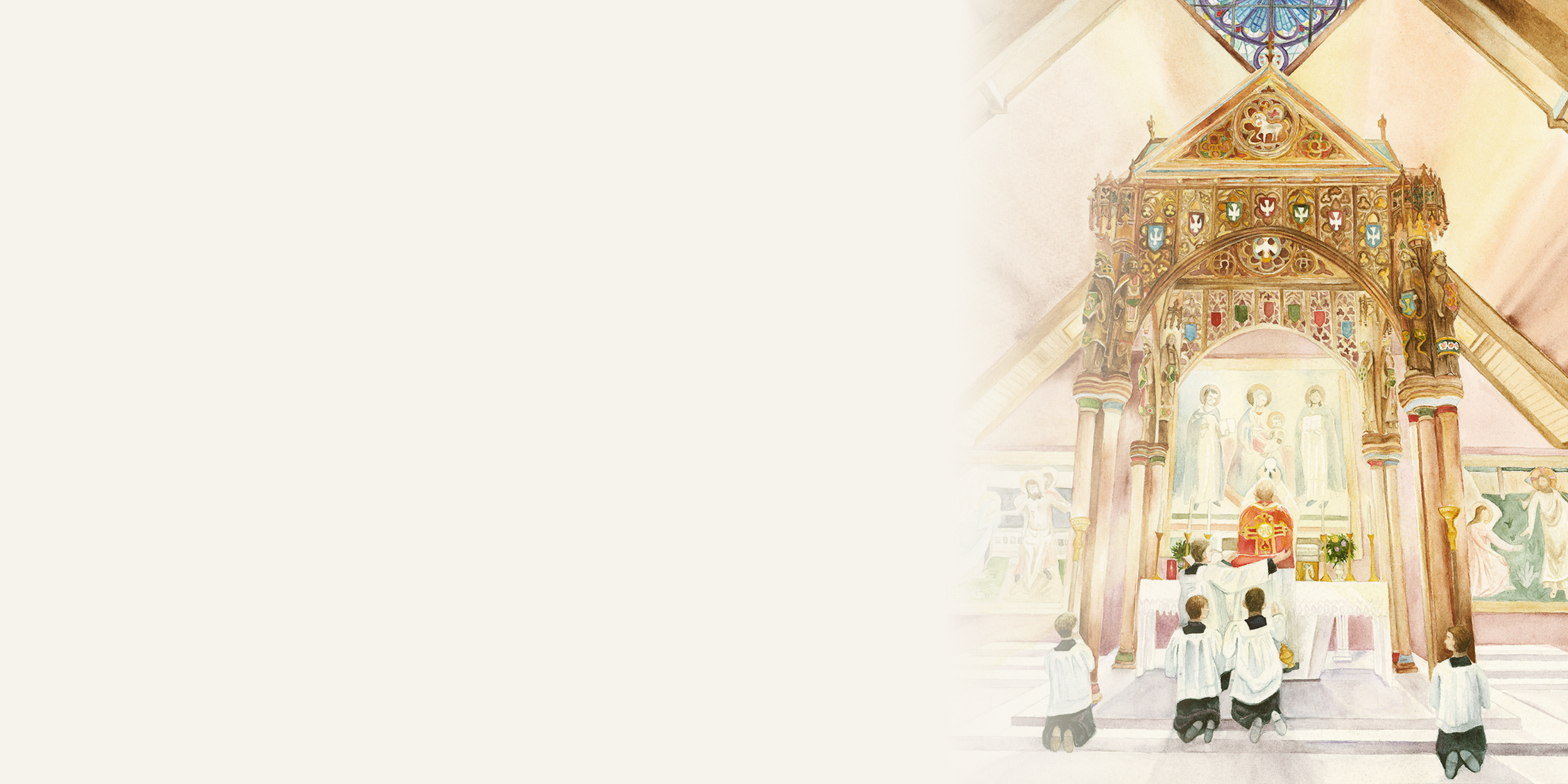
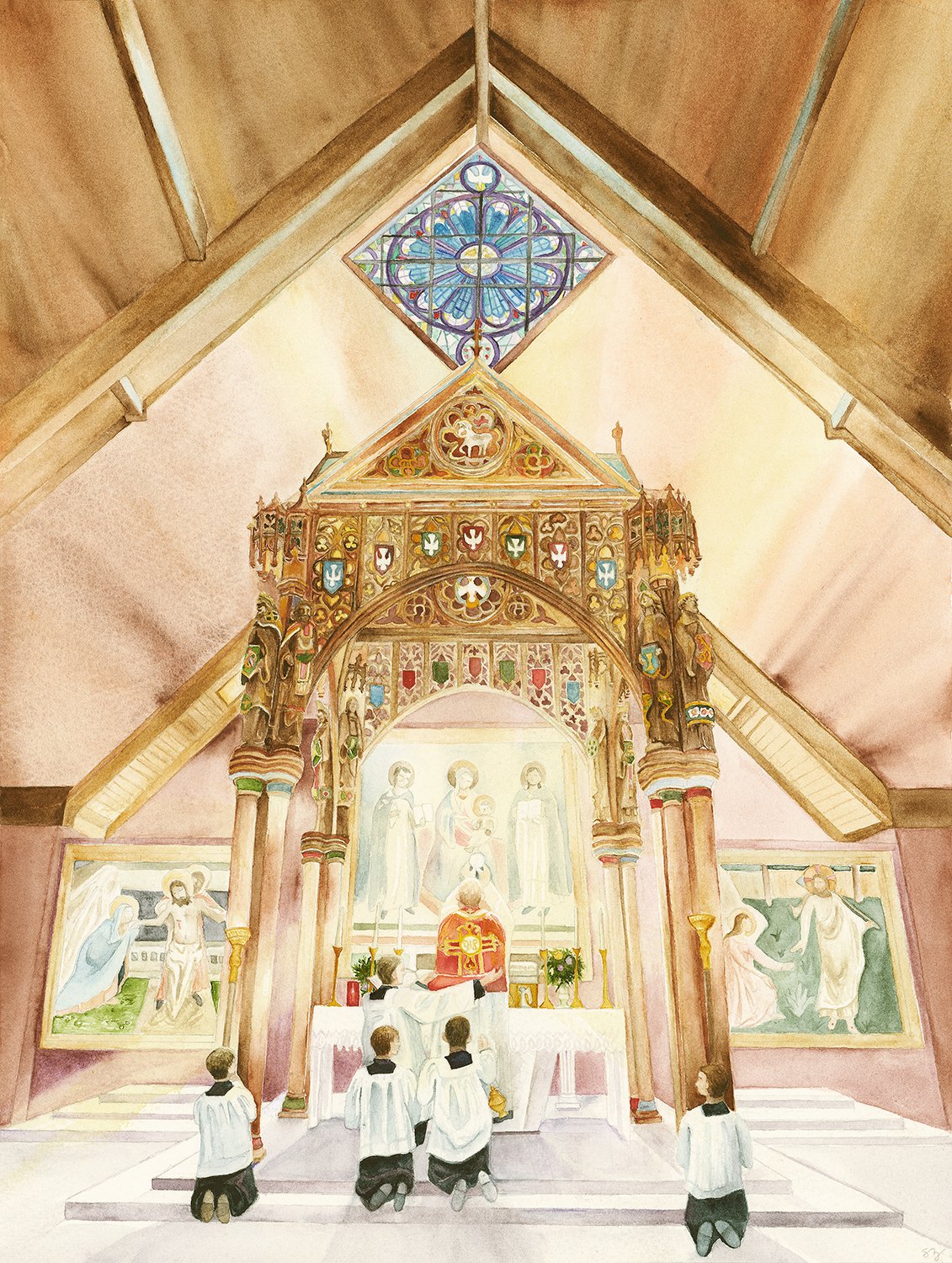
This original watercolor by Shannon Zabawa captures the sanctuary of St. Thomas Aquinas Catholic Church in Charlotte, North Carolina at the moment of the Elevation during the Feast of Pentecost. Painted in luminous transparent watercolor, the work reflects not only the beauty of one of North Carolina’s most remarkable Catholic sanctuaries but also the enduring mystery of the Eucharist and the descent of the Holy Spirit upon the Church.
The Watercolor Story
At a Glance
Artist: Shannon Zabawa
Artwork Title: Veni, Sancte Spiritus
Medium: Original Watercolor
Collection: 
Studio: Lux Benedicta Studio
Church: St. Thomas Aquinas Catholic Church
Location: Charlotte, North Carolina
Diocese: Diocese of Charlotte
Liturgical Moment: Elevation of the Holy Eucharist during Pentecost
Theme: The descent of the Holy Spirit and the Eucharistic mystery
This painting depicts Pentecost unfolding within the Holy Sacrifice of the Mass, where the mystery celebrated fifty days after Easter is renewed in every Eucharistic liturgy.
Following the Ascension of Our Lord, the Apostles gathered with the Blessed Virgin Mary in prayerful expectation, awaiting the Advocate whom Christ had promised. When the Holy Spirit descended with the sound of a mighty rushing wind and tongues of fire, fearful disciples became courageous witnesses, and the Church began her mission to proclaim the Gospel to every nation.
That same Spirit continues to animate the Church today.
At the center of the composition, brilliant light radiates from the consecrated Host, symbolizing both the Real Presence of Christ in the Eucharist and the continual outpouring of divine grace upon His Church. The warm reds that fill the sanctuary recall the traditional liturgical color of Pentecost and evoke the tongues of fire that descended upon the Apostles in the Upper Room.
Every compositional line leads toward the altar. The priest stands ad orientem, facing the Lord together with the congregation, directing all attention toward Christ present in the Blessed Sacrament. The altar becomes the meeting place of heaven and earth—the source from which the Church receives her life, mission, and strength.
Painted with luminous washes and delicate transparency, the watercolor invites quiet contemplation. Rather than illustrating a historical event, it reveals the Church’s perpetual Pentecost: the Holy Spirit continually sanctifying souls through the sacraments and drawing the faithful ever more deeply into communion with the Most Holy Trinity.
“And suddenly there came from heaven a sound like a mighty rushing wind…” — Acts 2:2
From Sanctuary to Watercolor: The Painting Process
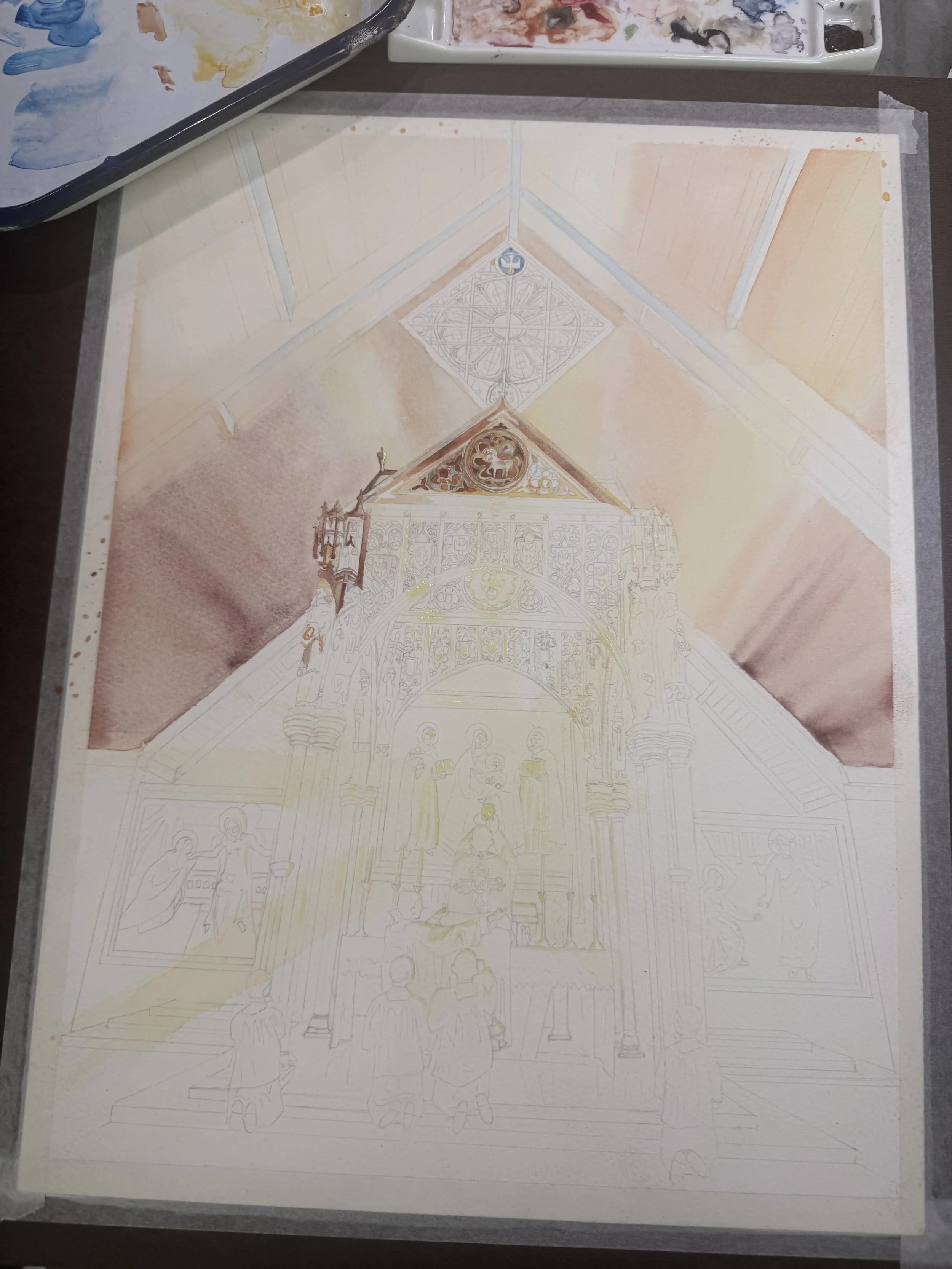
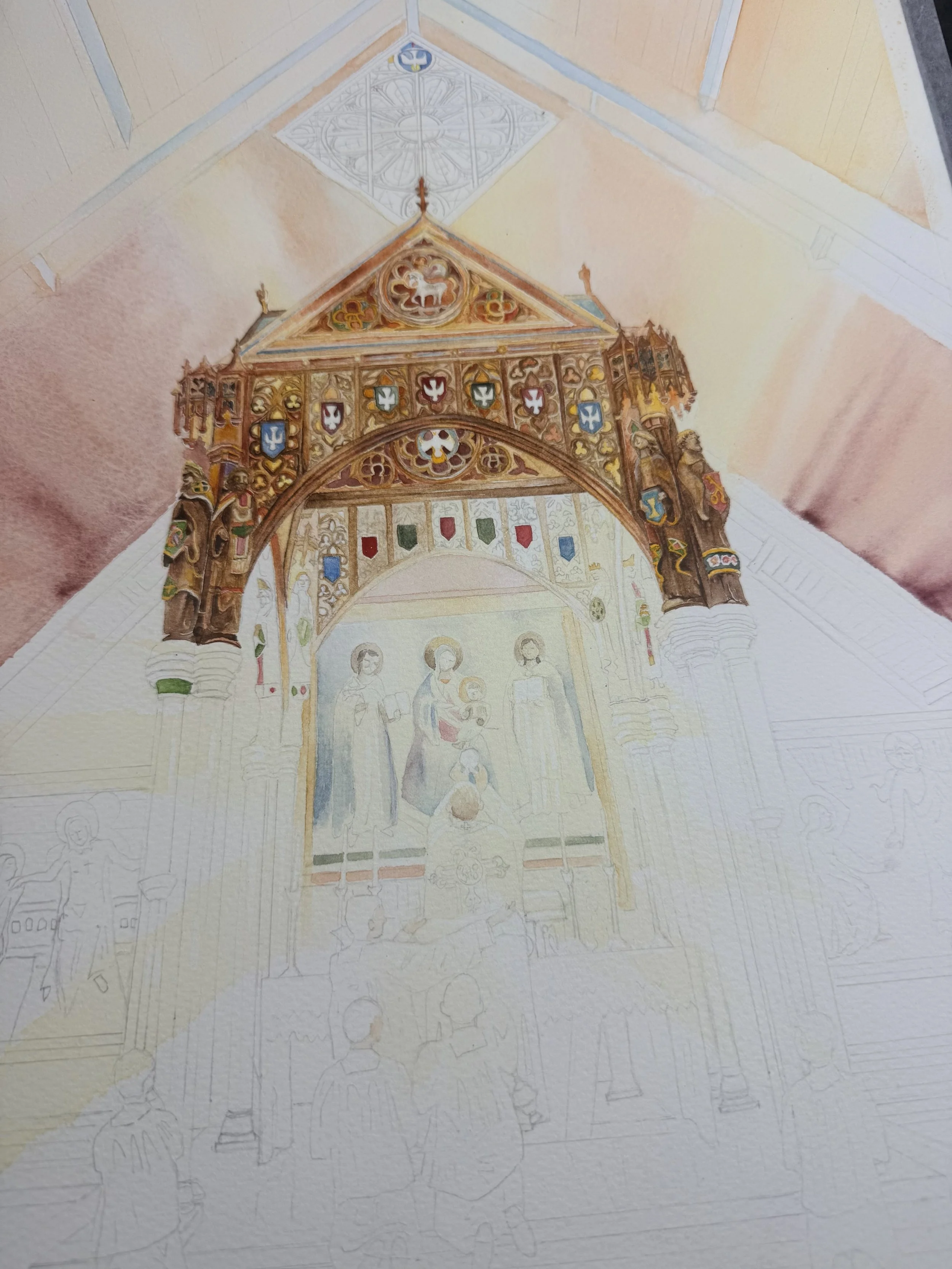
Every watercolor begins with careful observation of the sacred space itself. Shannon Zabawa studies the architecture, iconography, and light of the sanctuary before translating the scene through layers of transparent pigment.
Liturgical Significance
Pentecost is more than the conclusion of the Easter season. It is the birthday of the Church and the fulfillment of Christ’s promise never to abandon His people.
The sanctuary itself becomes a visual catechism.
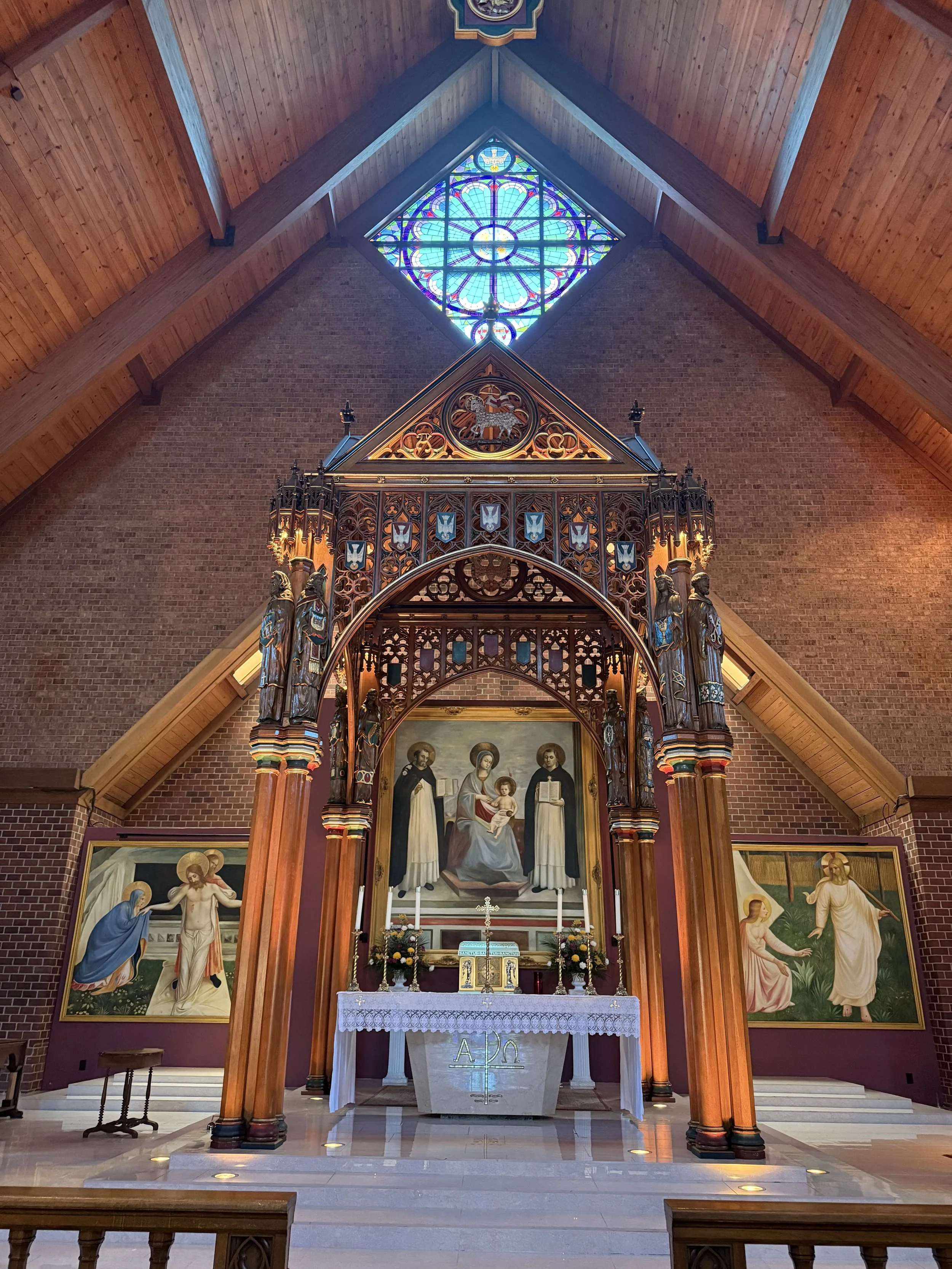
Towering above the altar stands the magnificent ciborium, proclaiming Christ’s kingship while drawing the eye heavenward. Within its structure appear Saint Peter holding the Keys of the Kingdom, the Lamb of God enthroned in glory, and the ancient symbols Alpha and Omega, declaring Christ as the beginning and the end of all history.
Descending beside the ciborium are seven doves representing the Seven Gifts of the Holy Spirit: Wisdom, Understanding, Counsel, Fortitude, Knowledge, Piety, and Fear of the Lord. Their downward movement echoes the descent of the Holy Spirit at Pentecost and reminds the faithful that these gifts continue to be poured out through the life of the Church.
Behind the altar, the monumental image of the Virgin and Child enthroned with Saint Dominic and Saint Thomas Aquinas reflects the Dominican charism of contemplation, preaching, and fidelity to divine truth.
On either side of the sanctuary hang works inspired by Fra Angelico depicting Christ’s Entombment and the Noli Me Tangere. Together they frame the altar with the Paschal Mystery—from sacrifice to resurrection—revealing that Pentecost cannot be separated from Christ’s Passion, Death, Resurrection, and Ascension.
Every artistic element ultimately directs the viewer toward the Eucharist, the source and summit of Christian life.
Architectural Details
St. Thomas Aquinas Catholic Church possesses one of the most distinctive sanctuaries in the Diocese of Charlotte, shaped by a renewed appreciation for classical Catholic architecture and sacred art.
Its Renaissance-inspired sanctuary draws heavily from centuries of Catholic artistic tradition. The soaring ciborium forms the architectural centerpiece, emphasizing the altar as the spiritual heart of the church. Rich marble, carefully proportioned columns, gilded ornamentation, and extensive iconography create an environment intended not merely to impress but to teach the faith through beauty.
The sanctuary reflects the Church’s historic understanding that sacred architecture serves a theological purpose. Every proportion, image, and material exists to elevate the mind toward God and reinforce the centrality of the Eucharistic sacrifice.
This watercolor seeks to preserve not only the visual beauty of the sanctuary but also the theological vision embodied within its architecture.
St. Thomas Aquinas and the Traditional Latin Mass
The sanctuary of St. Thomas Aquinas also holds a significant place in the recent history of the Traditional Latin Mass in the Diocese of Charlotte.
Following the wider restoration of access to the Traditional Latin Mass after the 1988 apostolic letter Ecclesia Dei and especially after Pope Benedict XVI’s 2007 apostolic letter Summorum Pontificum, communities attached to the older form of the Roman Rite grew throughout the United States.
In Charlotte, St. Thomas Aquinas became one of the churches where the Traditional Latin Mass was offered, eventually becoming one of the principal locations serving Catholics attached to the liturgy celebrated according to the 1962 Roman Missal. Along with St. Ann Catholic Church in Charlotte, Our Lady of Grace in Greensboro, and St. John the Baptist in Tryon, St. Thomas Aquinas was among the four parish churches in the Diocese of Charlotte that received permission to continue offering the Traditional Latin Mass following the 2021 publication of Pope Francis’ Traditionis Custodes. (catholicnewsherald.com)
For many faithful Catholics, the sanctuary became associated not only with the beauty of its architecture but also with a form of worship that emphasized silence, sacred music, Latin prayer, ad orientem worship, and the mystery of the Eucharistic sacrifice.
In 2025, the Diocese of Charlotte completed its implementation of Traditionis Custodes, ending celebrations of the Traditional Latin Mass in parish churches and designating a separate chapel in Mooresville as the location for the 1962 Roman Missal. The final Traditional Latin Mass at St. Thomas Aquinas was celebrated on October 2, 2025. (Diocese of Charlotte)
This watercolor preserves a moment connected to that history: an image of the altar at the center of Catholic worship, where generations of faithful have gathered to pray, receive the sacraments, and encounter Christ in the Eucharist.
The purpose of this artwork is not simply to document a building, but to preserve a sacred place and the spiritual reality it represents. Churches carry the prayers of those who worship within them, and sacred art serves as a witness to the faith, devotion, and traditions passed from one generation to the next.
History of St. Thomas Aquinas Catholic Church
Founded in 1978 to serve Charlotte’s growing Catholic population, St. Thomas Aquinas Catholic Church has become one of the largest and most prominent parishes in the Diocese of Charlotte. As the Catholic community expanded, the parish constructed its present church building, which was dedicated in 1995.
From its beginning, St. Thomas Aquinas has emphasized the importance of sacred worship expressed through beauty, reverence, and continuity with the Church’s artistic heritage. The church’s Renaissance-inspired sanctuary, magnificent ciborium, sacred artwork, and architectural details reflect the Catholic tradition that beauty can lift the mind and heart toward God.
In particular, the sanctuary has become known for its extraordinary ciborium, an architectural centerpiece that draws the eye toward the altar and the Eucharistic mystery celebrated there. The artistic program incorporates elements of Renaissance sacred art, including imagery of Saint Peter, the Lamb of God, Alpha and Omega symbolism, and representations connected to the Dominican spiritual tradition. These elements form a visual theology centered on Christ’s sacrifice, resurrection, and kingship.
Part of the Lux Perpetua Collection
This painting forms part of the Lux Perpetua Collection, a series of original watercolor paintings depicting four parish altars within the Diocese of Charlotte during the Elevation of the Host.
Each work corresponds to a season of the traditional liturgical year, allowing the collection to unfold as a visual meditation on Christmastide, Lent, Easter, and Pentecost.
Together, these paintings contemplate the enduring relationship between sacred worship, sacred architecture, and the theological truths expressed through the Church’s liturgy.
Explore the complete Lux Perpetua Collection to discover the story behind all four paintings.
Available Prints
Each reproduction is produced from a high-resolution archival scan of the original watercolor to preserve the transparency, luminous color, and delicate detail of the painting.
Available options include:
Museum-quality archival fine art paper
Multiple standard frame sizes
Ready-to-frame prints
Limited original artwork availability when offered
Every print is carefully inspected before shipment and is intended to become a lasting heirloom for the home, office, parish, or prayer space.
Whether displayed as a reminder of a beloved parish or as a meditation on the beauty of the Eucharistic liturgy, this artwork invites contemplation of the mysteries at the heart of the Catholic faith.