
Veni, Sancte Spiritus
“Come, Holy Spirit…”
This watercolor captures the profound mystery of Pentecost unfolding within the Holy Sacrifice of the Mass, where the descent of the Holy Spirit upon the Church is renewed in every Eucharistic celebration. Fifty days after Easter, the Church commemorates the moment when the Apostles, gathered with the Blessed Virgin Mary in prayerful expectation, received the promised Advocate. The rushing wind, tongues of fire, and sudden outpouring of divine power transformed fearful disciples into courageous witnesses, sending them forth to proclaim the Gospel to the ends of the earth. Pentecost marks not only the birth of the Church but also the fulfillment of Christ’s promise that He would remain with His people through the abiding presence of the Holy Spirit.
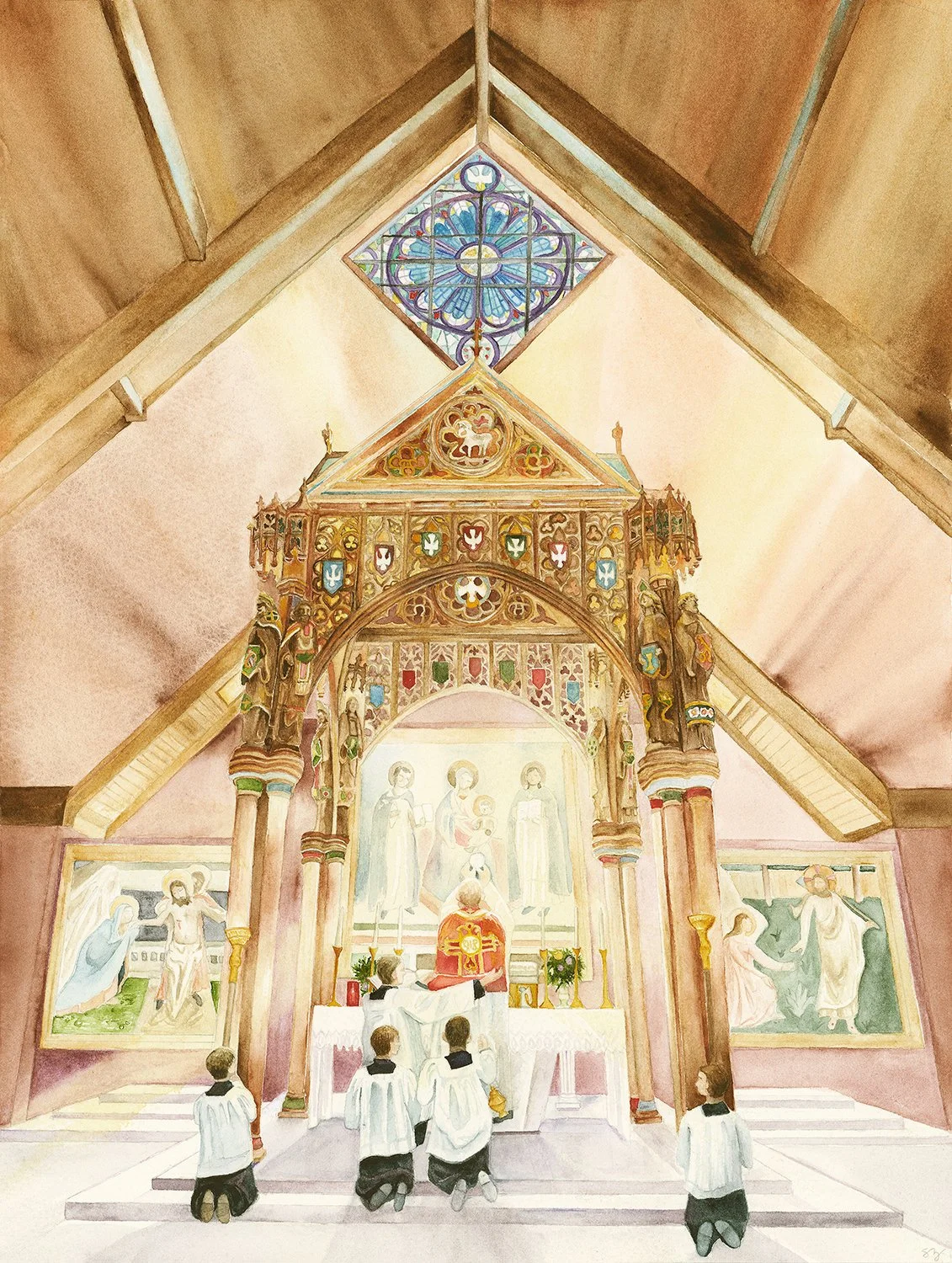
The choice of Pentecost as the subject of this painting reflects the Church’s continual dependence upon the Holy Spirit. Between the Ascension and Pentecost, the Apostles waited in hope, trusting in the words of Christ while longing for the gift He had promised. That sacred period of expectation mirrors the spiritual life of every Christian, who waits upon God’s grace and looks forward with confidence to the fulfillment of His promises. Pentecost reminds the faithful that God does not abandon His people; rather, He strengthens, guides, and sanctifies them through the power of the Holy Spirit.
At the center of the composition, brilliant light radiates from the consecrated Host, symbolizing both the Real Presence of Christ in the Eucharist and the outpouring of divine grace upon the Church. The warm tones of red that fill the sanctuary evoke the traditional liturgical color of Pentecost, recalling the tongues of fire that descended upon the Apostles in the Upper Room. Throughout Christian tradition, fire symbolizes the transforming power of God—purifying, illuminating, and inflaming the soul with divine charity. The radiant light flowing outward from the altar serves as a reminder that the same Holy Spirit who descended at Pentecost continues to sanctify the faithful through the sacraments, especially through the Eucharist, the source and summit of Christian life.
The priest stands ad orientem, facing the altar and leading the congregation in a common direction of worship toward God. Rather than addressing the people, he stands with them before the sacred mysteries, offering the Holy Sacrifice on behalf of the Church. Every line of the composition converges upon the altar, emphasizing Christ’s Eucharistic presence as the heart of the Church’s worship and mission.
Rich layers of sacred symbolism surround the altar. Towering above is the magnificent ciborium, a visual proclamation of Christ’s kingship and the continuity of the apostolic faith. Within its structure appears Saint Peter holding the keys entrusted to him by Christ, symbolizing the authority of the Church founded upon the Apostles. Above him stands the Lamb of God, recalling the sacrificial Lamb of the Book of Revelation who was slain yet lives forever. Embedded within the ciborium are the ancient symbols Alpha and Omega, the first and last letters of the Greek alphabet. These titles, drawn from Sacred Scripture, proclaim Christ as the beginning and the end of all things, the Lord of history who reigns from eternity to eternity.
Descending along either side of the ciborium are seven doves, their downward movement echoing the descent of the Holy Spirit at Pentecost. Together they symbolize the Seven Gifts of the Holy Spirit bestowed upon the faithful: wisdom, understanding, counsel, fortitude, knowledge, piety, and fear of the Lord. Their presence reinforces the central theme of the painting—that the Holy Spirit continually pours His gifts upon the Church, equipping believers to grow in holiness and bear witness to Christ in the world.
The artwork surrounding the sanctuary further enriches the theological narrative. Behind the altar stands the image of the Virgin and Child enthroned with Saint Dominic and Saint Thomas Aquinas, a visual testimony to the Dominican tradition’s devotion to both truth and contemplation. The Blessed Mother presents Christ to the world, while the two great saints represent lives shaped by preaching, study, and fidelity to divine revelation.
To the left appears Fra Angelico’s Entombment, depicting the burial of Christ attended by the Blessed Virgin Mary, Saint John the Evangelist, and Saint Nicodemus. This scene recalls the sorrow of Good Friday and the sacrifice that made salvation possible. Opposite it stands Fra Angelico’s Noli Me Tangere (“Do Not Touch Me”), portraying the encounter between the Risen Christ and Saint Mary Magdalene on Easter morning. Together these works form a visual journey from death to resurrection, from the silence of the tomb to the triumph of new life. Positioned on either side of the altar, they remind the viewer that Pentecost cannot be separated from the Paschal Mystery. The Holy Spirit descends because Christ first suffered, died, rose again, and ascended to the Father.
Painted with luminous washes and delicate transparency, this watercolor invites the viewer into contemplation of the Church’s perpetual Pentecost. The interplay of red, gold, and radiant light conveys both the majesty and intimacy of divine grace at work within the liturgy. It is a meditation on fire, mission, and transformation—a reminder that the Holy Spirit who descended upon the Apostles continues to descend upon the Church today, filling hearts with faith, strengthening souls with grace, and drawing all people into the life of the Most Holy Trinity.
“And suddenly there came from heaven a sound like a mighty rushing wind, and it filled the entire house where they were sitting.”
— Acts 2:2
