
Donec Venias
“Until You Come” (1 Corinthians 11:26)
This watercolor captures one of the most solemn and triumphant moments of the Easter Vigil: the elevation of the Holy Eucharist as the Church proclaims Christ’s definitive victory over sin, death, and the powers of darkness. Celebrated on the night that stands at the very heart of the liturgical year, the Easter Vigil begins in darkness and culminates in radiant light, tracing salvation history from creation to resurrection. It is the night when the Church keeps watch at the tomb, rejoices at the Resurrection, and renews her hope in the promise of eternal life.
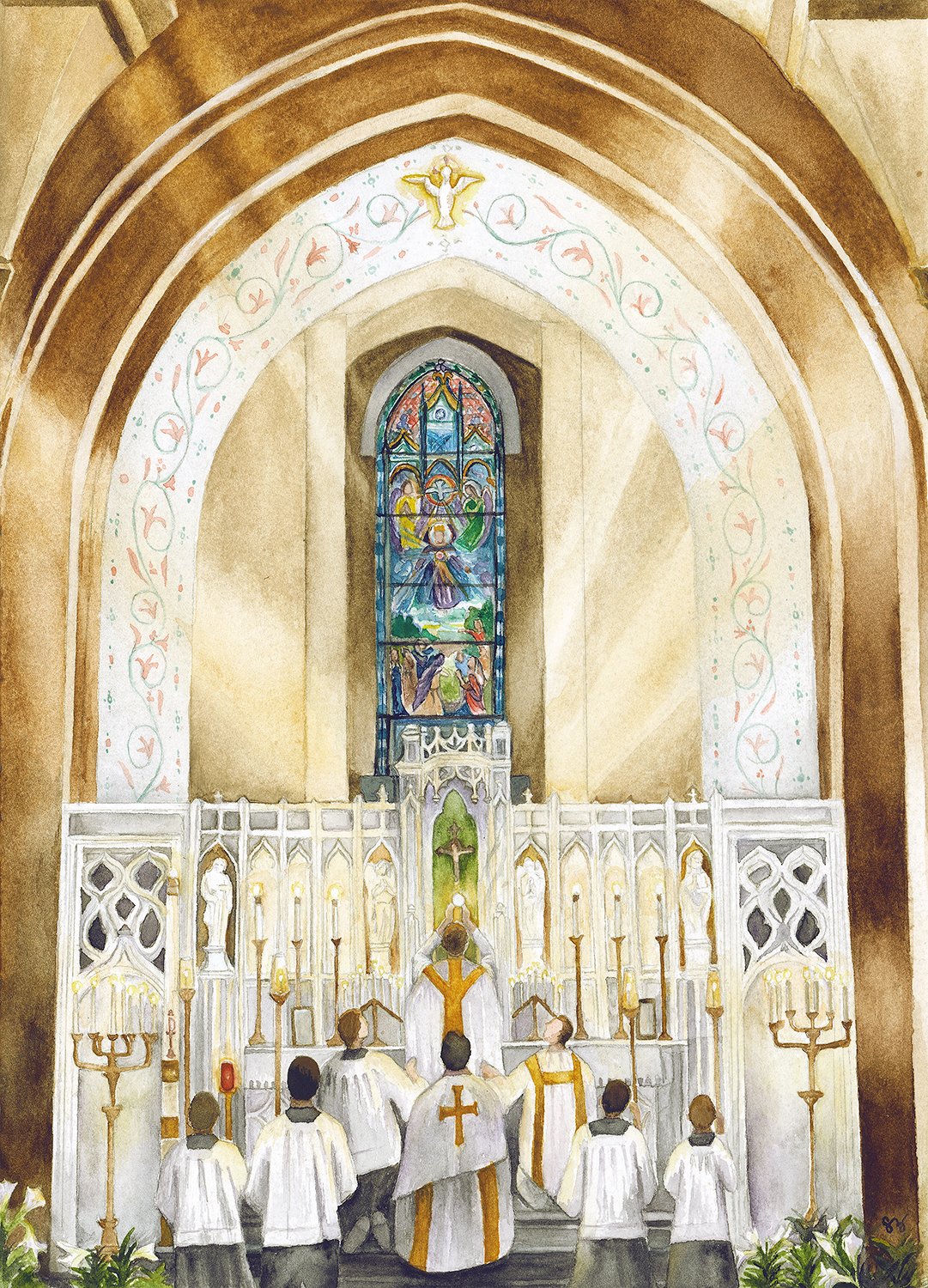
The setting of the Easter Vigil was chosen intentionally for this work because it embodies the central message of the Christian faith: Christ has risen, and through His Resurrection all things are made new. Throughout the liturgy, darkness gradually gives way to light as the Paschal Candle is carried into the church and the faithful receive its flame, a visible reminder that Christ is the Light of the World. The sanctuary depicted in this painting reflects that movement from shadow into glory. White vestments, luminous architecture, and golden candlelight fill the scene with a sense of purity, renewal, and joyful expectation. These elements symbolize not only the Resurrection itself but also the hope that flows from it—the promise that suffering, sorrow, and even death do not have the final word.
Beneath soaring Gothic arches, the priest stands ad orientem, facing the altar and leading the faithful in worship toward God. Servers and clergy kneel in reverent silence before the sacred mystery unfolding upon the altar. At the center of the composition, the consecrated Host is elevated high above the altar, radiant with light. The Eucharist becomes the visual and spiritual focal point of the painting, reminding the viewer that the same Christ who emerged victorious from the tomb remains truly present among His people in the Blessed Sacrament. The Resurrection is not merely remembered; it is made present sacramentally through the Holy Sacrifice of the Mass.
The eye is then drawn upward through the sanctuary to the great stained-glass image of the Blessed Virgin Mary, enthroned in heavenly glory. Here Mary is presented under the title of Our Lady of Grace, a title that reflects her maternal role in God’s plan of salvation and her continual intercession for the Church. Positioned above the altar, she does not draw attention to herself but gently directs every gaze toward her Son. This reflects the timeless truth expressed throughout Catholic tradition: Mary’s mission is always to lead souls to Jesus. Her presence in the composition serves as a reminder that she accompanies the faithful on their pilgrimage of faith, guiding them ever more deeply into the mystery of Christ’s sacrifice, Resurrection, and Eucharistic presence.
The Easter season itself is a prolonged celebration of this mystery. For fifty days, the Church rejoices in the triumph of the Risen Christ and anticipates the fullness of His Kingdom. It is a season marked by hope, renewal, and joyful expectation, inviting believers to live as people transformed by the Resurrection. The abundance of white throughout the painting recalls the baptismal garments worn by the newly initiated during the Easter Vigil and symbolizes purity, redemption, and participation in Christ’s victory. The interplay of light throughout the sanctuary further emphasizes the Christian conviction that no darkness—whether sin, suffering, uncertainty, or death—can overcome the light of Christ.
The title, Donec Venias, meaning “Until You Come,” is drawn from Saint Paul’s words concerning the Eucharist: “For as often as you eat this bread and drink the cup, you proclaim the death of the Lord until He comes” (1 Corinthians 11:26). The phrase beautifully unites the themes of the painting. The Mass is both a remembrance of Christ’s Passion and a participation in His Resurrection. It looks backward to Calvary, celebrates His living presence in the Eucharist, and looks forward in hope to His glorious return. Standing at the intersection of memory, presence, and expectation, the faithful worship the Risen Lord while awaiting the fulfillment of His promises.
Painted with delicate washes and luminous transparency, this watercolor invites contemplation of the profound mystery celebrated on the Church’s holiest night: that Christ has conquered death, remains present in the Eucharist, and continues to draw His people toward eternal life. It is a meditation on resurrection, worship, hope, and the enduring promise that the Light of Christ shines into every darkness.
“The light shines in the darkness, and the darkness has not overcome it.”
— John 1:5
