
Our Lady of Grace
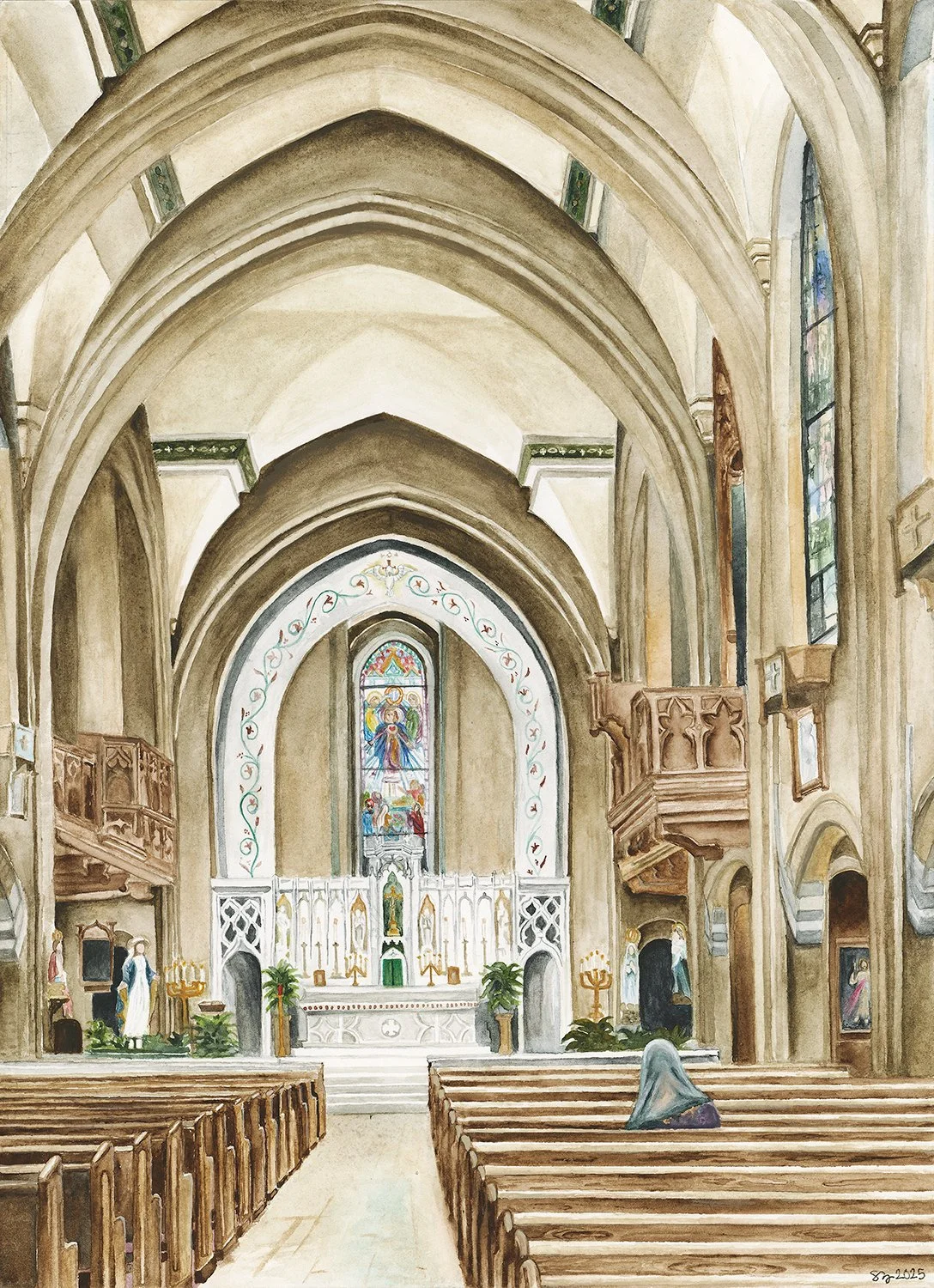
This watercolor captures the quiet majesty of Our Lady of Grace Catholic Church, drawing the viewer into the sacred stillness of its soaring Gothic arches and luminous sanctuary. More than an architectural portrait, the painting serves as a meditation on the transcendence of God and the humble place of humanity before Him. The vast interior stretches upward and outward in a symphony of stone, light, and sacred design, creating a sense of awe that has inspired worshippers for centuries. Every line of the composition leads the eye toward the altar, the true heart of the church and the focal point of Catholic worship, where heaven and earth meet in the celebration of the Holy Eucharist.
“How lovely is your dwelling place, O LORD of hosts! … Happy are those who live in your house, ever singing your praise.”
- Psalm 84
Bathed in gentle daylight, the sanctuary radiates a quiet splendor that speaks of God’s majesty and enduring presence. The towering arches and immense scale of the church are not merely architectural achievements; they are visual expressions of a theological truth. Sacred architecture has long sought to lift the mind and heart beyond the ordinary, reminding the faithful that they stand in the presence of the Creator of heaven and earth. The grandeur of the space evokes both reverence and wonder, inviting the viewer to contemplate the greatness of God whose glory cannot be contained by any earthly structure, yet who graciously chooses to dwell among His people.
At the center of the composition stands the altar, illuminated as the spiritual destination toward which the entire church is ordered. It is here that the sacrifice of Calvary is made present in the Holy Sacrifice of the Mass and where Christ comes sacramentally to His people in the Eucharist. The visual prominence of the altar reflects its central role in Catholic life: the place of encounter with the living God. Even amid the beauty of the architecture, the altar remains the focal point, quietly proclaiming that every aspect of the church exists to direct souls toward Christ.
Above the sanctuary shines the great stained-glass image of Our Lady of Grace, enthroned in heavenly glory and surrounded by angels. Her elevated position above the altar reflects her unique place within salvation history and her enduring role within the life of the Church. As Mother of God and Mother of the faithful, Mary continually points beyond herself to her Son. Throughout Christian tradition, she is understood as the one who leads souls to Christ, interceding for her children and guiding them toward deeper faith and trust in God’s providence. Her title, Our Lady of Grace, recalls the abundance of spiritual gifts bestowed through her cooperation with God’s plan and her maternal care for all who seek her aid.
The presence of Mary is echoed throughout the sanctuary, appearing not only in the luminous stained glass but also in statuary that quietly watches over the sacred space. These representations remind the faithful that the communion of saints surrounds the Church in her earthly pilgrimage. Mary’s presence is neither ornamental nor incidental; rather, it reflects the Church’s understanding of her as a loving mother who accompanies believers on their journey toward Christ. Positioned within the house of God, she appears as both guide and intercessor, inviting all who enter to draw nearer to her Son.
Amid the immensity of the sanctuary, a solitary woman kneels in prayer. Her small figure is intentionally dwarfed by the towering architecture surrounding her, emphasizing both the grandeur of God’s house and the humility proper to those who enter it. Yet her apparent smallness does not suggest insignificance. Rather, it reveals a profound spiritual truth: before the infinite majesty of God, every human person is humble and dependent, yet infinitely loved. The contrast between the vast sanctuary and the solitary worshipper highlights the mystery of a God who governs the universe while also hearing the quiet prayers of a single soul.
The woman becomes a point of identification for the viewer. Her posture of prayer embodies the response that sacred spaces are designed to inspire: wonder, reverence, gratitude, and trust. In the stillness of the church, she represents every believer who enters seeking consolation, guidance, forgiveness, or simply a moment of peace in the presence of God. Though physically small within the composition, she occupies a place of immense dignity, standing before the Lord as a beloved daughter and a member of His family.
Through layered washes of warm stone, filtered light, and delicate architectural detail, the painting seeks to capture both the intimacy of personal prayer and the overwhelming majesty of divine worship. It reflects the paradox at the heart of the Christian faith: that the God who created the stars and sustains the universe invites each soul into a personal relationship with Him. Beneath the watchful gaze of Our Lady of Grace and before the altar where Christ comes to His people, the viewer is invited to enter the same silence, to contemplate the greatness of God, and to discover the peace that can only be found within His presence.
“My soul magnifies the Lord, and my spirit rejoices in God my Savior.”
— Luke 1:46–47